

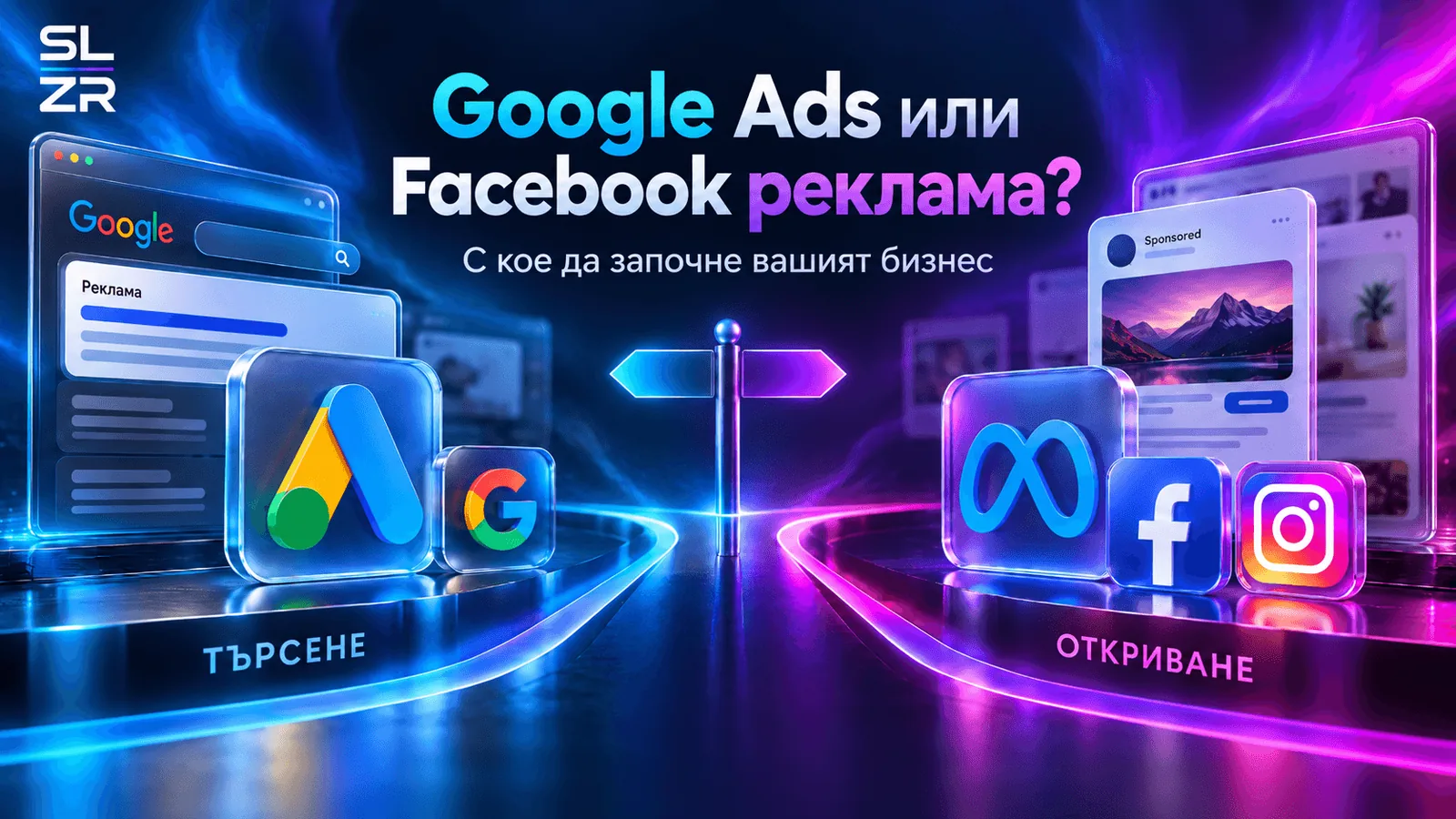
If you own a small or medium-sized business and you’re investing in paid advertising for the first time, you’ve probably faced this exact choice: Google Ads or Facebook ads? Both platforms deliver results, but they work in fundamentally different ways — and understanding that difference is the key to not spreading your budget across two places at once. In this article, we look at how each platform works, who it’s best suited for, and how to make the right call for your business.
How Google Ads works
Google Ads is search-based advertising. When someone types “web design agency” or “cleaning company Sofia” into Google, they already have a specific problem and are actively looking for a solution — your ad appears at the exact moment they’re searching for it.
That makes Google Ads an extremely powerful tool for capturing ready-made demand. People who click are usually in an active buying phase — they already want the service and are comparing offers, which is why conversions tend to be faster and more predictable.
Google Ads is best suited for businesses where the customer actively searches for a solution: lawyers, dentists, construction companies, electronics stores, repair and installation services. That’s exactly the case for Carport.bg, a carport manufacturer we worked with — before our work together they had no online presence at all, and people searching for “car carport” already know exactly what they want; they just need to find you. If your product solves a clear, urgent problem, Google Ads is the logical place to start.
How Facebook ads work
Facebook ads (together with Instagram) work on a completely different principle. Here, you’re not waiting for someone to find you — you’re putting your product in front of people who don’t yet know they need it. The algorithm shows ads in people’s feeds based on their interests, behavior and demographics.
Facebook and Instagram ads are ideal for building awareness and for products with strong visual appeal. Fashion, cosmetics, food, furniture, fitness, online courses — anything that looks great in a photo or video performs well here. At Fée Bridal, a wedding dress boutique, the visual power of Instagram and Facebook brought in future brides who would never have found the brand on their own.
The upside is that you can build an audience of people who otherwise would never have discovered you. The downside is that these people aren’t in an active buying phase, so results tend to come more slowly and require more patience and testing.
The key differences between Google Ads and Facebook ads
To choose correctly, it helps to see the two platforms side by side:
- Intent — Google captures people who are already searching for a solution; Facebook creates demand where none existed yet.
- Speed of results — Google often delivers faster conversions; Facebook needs time to build an audience.
- Cost — Google Ads usually has a higher cost per click because competition for ready-made demand is fierce; Facebook is often cheaper per click, but with a lower conversion rate at first.
- Visuals — Facebook relies on strong images and video; Google relies on text and search relevance.
- Targeting — with Facebook you can target very precisely by interest; with Google you target by keyword and location.
- Best for — Google: urgent needs and services; Facebook: visually appealing products and brand building.
There’s no “better” platform — there’s the platform that’s better suited to your specific business and product.
How to decide which one to start with
The right choice depends on your business, not on which platform is “better.” Ask yourself these three questions:
- Does your customer actively search for a solution? If yes — say, they search for “cleaning company” or “web design agency” — start with Google Ads. You capture ready-made demand and get faster results.
- Does your product sell well visually? If you sell fashion, cosmetics, food, or services that look great in a photo, Facebook ads can bring you customers who would never have searched for you on their own.
- What’s your budget? If your budget is limited, it’s better to put everything into one platform than to split it between two. A smaller budget in one well-optimized campaign almost always beats a scattered budget spread across two.
What to do if your budget is limited
A common mistake is launching on both Google and Facebook at once with a small budget. The result is weak data on both platforms, with no clear conclusion about what’s actually working.
The better approach: start with one platform, give it 4 to 6 weeks to gather data, and only then decide whether to scale it up or add the second one. Once a campaign shows you what works, you can carry those lessons over to the other platform.
Frequently asked questions
Can I use both platforms at the same time?
Yes, many businesses do this successfully. But it’s wiser to start with one, stabilize it, and only then add the second.
Which platform is cheaper?
Facebook usually has a lower cost per click, but Google often delivers a better return because people are already searching for the solution. It all depends on your business.
How long does it take to see results?
With Google Ads, the first results can come within a few weeks. With Facebook ads, it’s normal to take 1 to 2 months while the algorithm optimizes your campaign.
Conclusion
Google Ads and Facebook ads aren’t competitors — they’re two different tools for two different jobs. Google captures ready-made demand and delivers faster results, while Facebook builds awareness and reaches people who don’t know you yet.
The choice starts with your business: if your customers actively search for a solution, start with Google Ads. If your product sells visually and you want to build a brand, start with Facebook ads. Either way — don’t spread your budget thin. Put it into one well-optimized campaign, gather data, and then expand.
If you’re not sure where to start, the SALAZAR team can help you set up your first campaign — whether that’s Google, Facebook or Instagram ads. Get in touch for a free consultation and we’ll help you choose the channel that brings results for your business.