



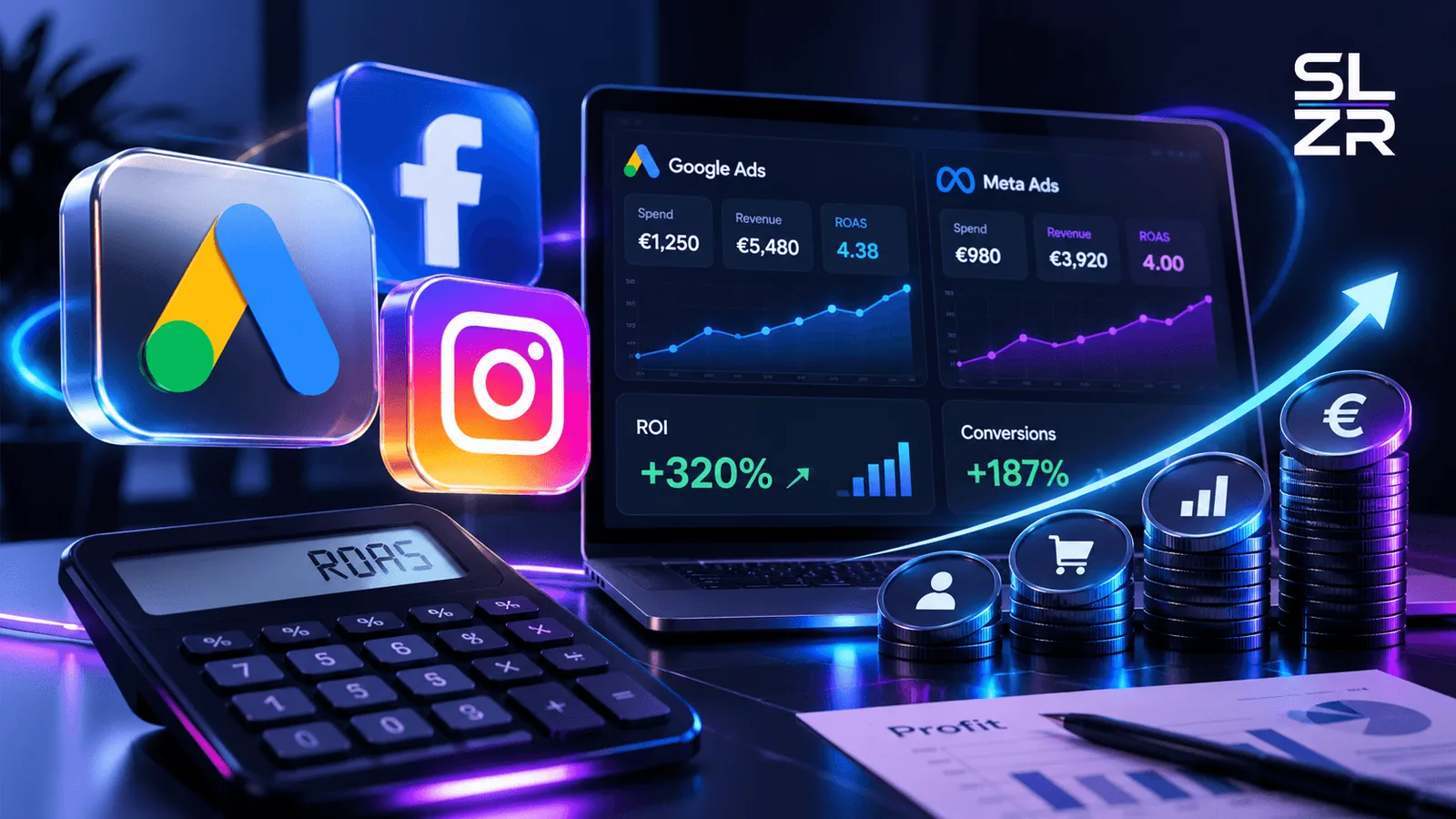
Spending money on Facebook, Instagram or Google ads but not sure if it's actually paying off? If that sounds familiar, you're not alone — a lot of small and medium business owners run ads without being able to say exactly how much profit every euro they spend brings back. In this article we'll show you how to set up tracking correctly, measure conversions, and calculate the real return on your ad investment.
Why measuring matters more than the ad itself
Advertising without measurement is like driving with your eyes closed. You might be moving, but you don't know if you're headed in the right direction. When you know exactly how much a customer costs and how much profit they bring, you make decisions based on data, not gut feeling. That's how you stop pouring money into channels that don't work and start doubling down on the ones that do.
What ROAS and ROI actually mean
The two terms get mixed up often, but they measure different things:
- ROAS (Return On Ad Spend) shows how much revenue every euro spent on ads generates. It's calculated by dividing ad revenue by ad spend.
- ROI (Return On Investment) shows how much profit the investment brings once you subtract all costs — including the cost of the product, shipping, and other operating expenses.
In simple terms: ROAS tells you how much revenue your ads bring in, while ROI tells you how much of that is actual profit. Both matter, but for your bottom line, ROI is what decides.
Step 1: Set up tracking correctly
You can't measure anything without tracking what your visitors actually do. Start with three basics:
- Install the Meta pixel (Facebook and Instagram) and the Google Ads tag, so you know who's clicking on your ads.
- Set clear conversions: a purchase, a completed form, a phone call, or a newsletter signup.
- Connect your ad platforms to analytics, so you can see the customer's path from first click to purchase.
If tracking isn't set up correctly, every number that follows will be wrong. This is the single most common reason businesses think their ads aren't working, when really they just aren't measuring them properly.
Step 2: Measure your conversions
A conversion is any desired action a visitor takes on your site. To measure it, you need to know what you're aiming for — an inquiry, a sale, a signup? Once you've defined the goal, look at how many visitors reach it, and which channel they came from.
This is also the moment to pay attention to traffic quality. A hundred clicks from people who don't want your product are worth less than thirty clicks from exactly the right audience. So look past the click count and pay attention to what visitors actually do once they land on your site.
Step 3: Calculate your ROAS
The formula is simple:
ROAS = Ad Revenue ÷ Ad Spend
If you spent €1,000 on ads and they brought in €4,000 in revenue, your ROAS is 4 — every euro invested returns €4 in revenue.
But be careful: a high ROAS doesn't always mean profit. If your product has thin margins, even a ROAS of 4 might not cover all your other costs. That's exactly why the next step matters.
Step 4: Calculate your ROI
For the real picture, you need to factor in all your costs:
ROI = (Profit from Ads − Total Costs) ÷ Total Costs × 100
Total costs include your ad budget, product cost, shipping, order processing, and everything else tied to the sale. Only once you've subtracted all of that do you know whether your ads are bringing real profit or just the appearance of revenue.
Step 5: Act on the numbers
Measurement has no value if it doesn't lead to action. Once you know which campaigns and audiences are profitable, shift your budget toward them. When a channel isn't hitting the ROI you need, pause it or change your approach. Your ad budget isn't a fixed cost — it's a tool that needs constant optimization.
How SALAZAR helps
You don't have to do all of this yourself. SALAZAR handles tracking setup, conversion measurement, and campaign optimization for your Facebook, Instagram and Google ads. That's exactly what we do for Fée Bridal — clear tracking on every campaign shows them exactly which channel actually drives fitting bookings, not just clicks. We show you clearly what's working and what isn't, with transparent data and a focus on real business results: more qualified inquiries, customers, sales, and return on investment.
Conclusion
Measuring ROAS and ROI isn't a luxury — it's a necessity for any business advertising online. Set up your tracking, define your conversions, calculate the real profit on every euro invested, and act on the data. That's how you stop spending money in the dark and turn your advertising into a predictable source of growth.
If you'd like professional help measuring and optimizing the return on your online ads, get in touch with SALAZAR for a free consultation.